Last updated: August 2, 2026
Before you fill a toy box with anything labeled “educational,” it helps to know what actually builds a child’s thinking, and what is just clever marketing. STEM education toys for kids work best when they are safe, age-appropriate, and designed around how young children genuinely learn, through touch, repetition, and joyful trial and error, not through flashcards or screens. This guide walks UAE parents through exactly what STEM means for children aged 3 to 8, how to choose toys that are both safe and developmentally sound, and how to weave science, technology, engineering, and math into everyday family life at home.
What Is STEM Education, Really?
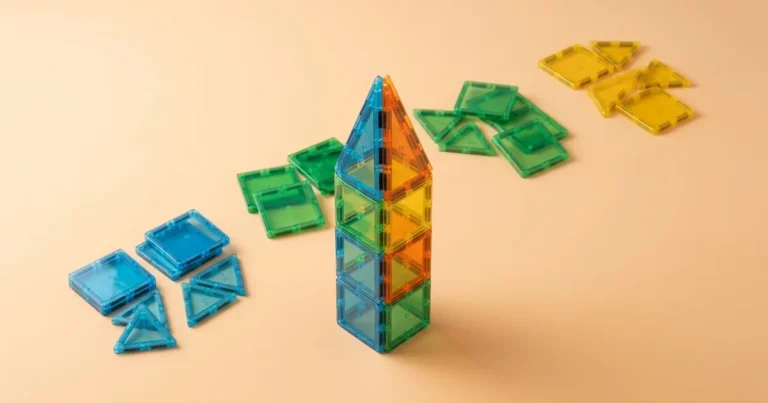
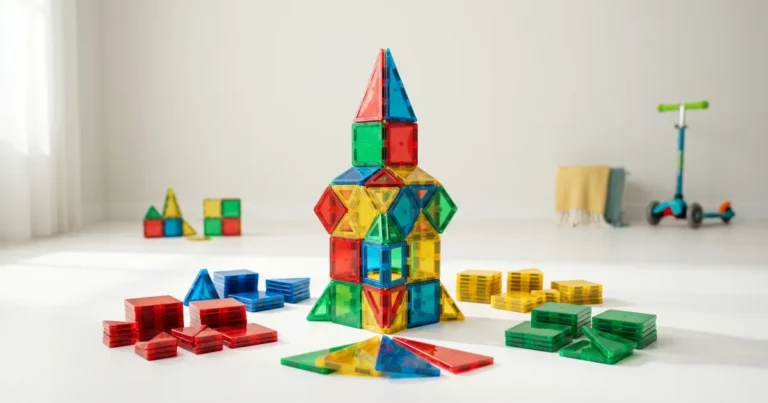
STEM stands for Science, Technology, Engineering, and Math, but for young children, it is not about formulas or lab coats. It is about curiosity in motion. A toddler stacking magnetic tiles is doing structural engineering. A five-year-old sorting colored blocks by size is doing early mathematics. A child mixing paint colors during a finger-painting session is running a science experiment. STEM education, at its heart, is simply a framework for the natural questions children already ask: why, how, what if.
Breaking Down Science, Technology, Engineering, and Math for Young Learners
For preschool and early primary years, each STEM pillar looks different than it does in a classroom for older students:
- Science is observation, prediction, and cause-and-effect play, like noticing that a magnet pulls another piece toward it.
- Technology is understanding how tools and simple mechanisms work, including how a toy train’s wheels roll along a track.
- Engineering is building, testing, and rebuilding, whether that is a block tower or a magnetic train track layout.
- Math is patterns, counting, shapes, and spatial reasoning, all of which show up constantly in construction-style play.
When these four elements blend together in open-ended play, children are not memorizing facts. They are building the mental scaffolding that will make later academic learning feel intuitive rather than intimidating.
Why STEM Matters More Than Ever in the UAE
The UAE’s national education vision places heavy emphasis on innovation, critical thinking, and future-ready skills, and this starts long before school age. Nurseries and kindergartens across Dubai, Abu Dhabi, and Sharjah increasingly integrate STEM stations into their daily curriculum. Parents who reinforce these concepts at home, through safe, well-designed toys, give their children a real head start, not by rushing academics, but by making problem-solving a natural, comfortable part of daily life.
The Science Behind Play-Based STEM Learning
Child development research consistently shows that children under 8 learn best through hands-on, multi-sensory experiences rather than passive instruction. This is not a trend, it is how the developing brain is wired to absorb information.
How Toddlers’ Brains Absorb STEM Concepts
Between ages 3 and 5, a child’s brain is forming an extraordinary number of neural connections, particularly in areas responsible for spatial reasoning, motor coordination, and problem-solving. When a toddler snaps two magnetic pieces together and feels that satisfying click, the brain registers cause and effect. Repeat this a hundred times over a few weeks, and the child begins predicting outcomes before they happen, an early and crucial form of scientific reasoning.
The Role of Repetition, Curiosity, and Sensory Exploration
Unlike adults, young children do not get bored of repetition, they get better because of it. A child who builds the same magnetic train track shape five times in one afternoon is not being unproductive. They are refining fine motor control, testing structural stability, and internalizing geometric patterns. This is why toys that reward repeated, hands-on manipulation, rather than single-use gadgets, offer far more developmental value over time.
STEM Education by Age Group
Not every STEM toy suits every child. Matching the toy to the developmental stage is one of the most important, and most overlooked, parts of choosing well.
Ages 3-5: Building Foundations Through Sensory and Fine Motor Play
At this stage, children are developing hand-eye coordination, basic shape and color recognition, and the ability to follow simple multi-step actions. The best toys here are large enough to be safe, simple enough to avoid frustration, and open-ended enough to allow imaginative building. A well-designed magnetic tile or train set is ideal because it introduces geometry and balance without requiring reading or complex instructions.
Parents shopping for this age group can explore a curated collection of toys for ages 3 to 5 years, which is organized specifically around safety and developmental appropriateness for this stage.
Ages 6-8: Introducing Logic, Patterns, and Early Engineering
By age 6, children can handle more complex multi-piece construction, sequencing, and basic planning. This is the age to introduce toys that require a bit of forward thinking, like designing a full magnetic train track with multiple loops and junctions, or building a structure that has to support weight without collapsing. These challenges build persistence and early engineering logic, skills that translate directly into later math and science confidence.
For this stage, browsing a dedicated collection for ages 6 to 8 years makes it easier to find toys that offer the right level of complexity without overwhelming younger siblings who might still want to join in.
Choosing Safe, High-Quality STEM Toys
Safety always comes first, especially with toys that involve small magnetic pieces, detachable parts, or anything that ends up in a toddler’s mouth during exploratory play.
Safety Certifications Every UAE Parent Should Check
Before adding any toy to your home, look for recognized safety certifications such as EN71 (European toy safety standard) or ASTM F963 (US standard), both of which test for choking hazards, toxic materials, and structural durability. Reputable toy brands sold in the UAE will clearly display these certifications on packaging or product pages. If a toy does not list any safety standard, it is worth asking the seller directly before purchasing.
Magnetic Toys: What to Look For
Magnetic building toys are among the most valuable STEM tools available for young children, but only when designed with safety in mind. Look for:
- Magnets that are fully sealed inside sturdy, non-toxic casing so they cannot be pried loose
- Rounded edges and smooth surfaces with no sharp points
- Pieces large enough that they are not a choking hazard for the intended age group
- Strong enough magnetic pull to build stable structures without pieces flying apart unpredictably
A well-built set like the Graflo Magnetic Train 65pcs STEM Tiles Set is designed with these safety principles in mind, giving parents peace of mind while children explore shapes, balance, and basic circuitry-style connections through open-ended building.
Avoiding Small Parts and Choking Hazards
The general safety rule for children under 3 is to avoid any toy piece smaller than a standard toilet paper tube opening. For children aged 3 and above who are past the mouthing stage, small pieces become less risky, but supervision is still important, especially in households with younger siblings crawling around the same play area. Always store smaller-piece STEM toys separately if you have a toddler under 3 in the home.
Best Types of STEM Toys for Home Learning
Not all STEM toys look like miniature robots or science kits. Some of the most effective options are simple, tactile, and open-ended.
Magnetic Building and Train Sets
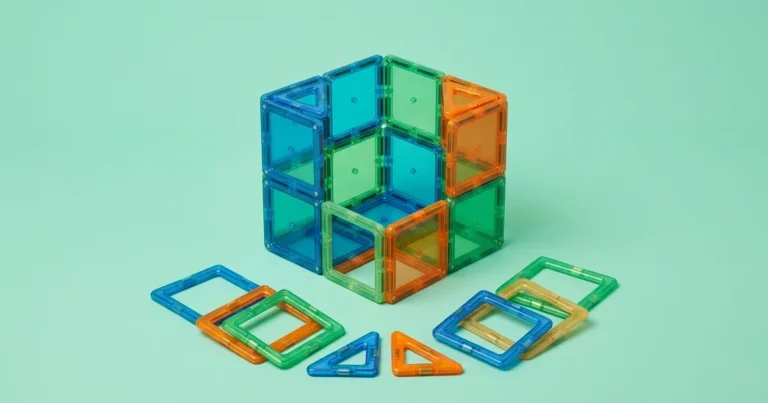
Magnetic tiles and train sets teach geometry, spatial planning, cause and effect, and fine motor precision, all at once. For younger children just starting out, a smaller, manageable set is ideal, while older children benefit from larger sets that allow more complex track designs. The 178-piece Magnetic Train Set is a strong option for families with children who are ready for bigger builds, multiple track configurations, and cooperative play with siblings or friends.
Creative and Sensory Toys (Art, Finger Painting)
STEM is not only about building and logic, creative exploration is a core part of scientific thinking too. Mixing colors, observing how paint textures change as they dry, and experimenting with pressure and blending all introduce basic chemistry and physical science concepts in a playful, mess-friendly way. A safe, non-toxic option like the 12-Color Finger Paint Set lets children explore color theory and sensory science with materials specifically formulated to be gentle on young skin and easy to wash off.
Puzzles, Blocks, and Pattern Games
Simple wooden puzzles, stacking blocks, and pattern-matching games build early math skills like sequencing, symmetry, and spatial reasoning. These toys are especially useful as a bridge activity between free-form building and more structured STEM learning later in primary school.
Bringing STEM Into Everyday Life at Home
You do not need a dedicated “STEM corner” or expensive kits to raise a curious, scientifically minded child. Everyday household moments are full of learning opportunities.
Kitchen Science
Cooking together is one of the richest STEM experiences available at home. Measuring ingredients teaches early math, watching batter rise in the oven teaches chemistry, and stirring, pouring, and mixing all build fine motor coordination. Simple, safe activities like watching ice melt in different temperatures of water or observing how oil and water separate can spark genuine scientific curiosity in a five-year-old.
Nature Walks and Outdoor Exploration
A walk around a Dubai park or a Sharjah garden becomes a science lesson when you pause to look at how ants move in lines, how leaves are shaped differently, or how shadows change length throughout the day. Bring a small magnifying glass along and let your child lead the exploration, asking questions rather than giving answers builds far stronger scientific thinking.
Simple Home Engineering Challenges
Challenge your child to build the tallest tower using cushions, or the longest bridge using magnetic tiles that can hold a small toy car without collapsing. These low-pressure challenges introduce engineering concepts like balance, load distribution, and trial-and-error problem solving, all through play that feels like a game rather than a lesson.
STEM Education in UAE Nurseries and Schools
Most nurseries and kindergartens across the UAE now include some form of STEM-focused learning in their weekly curriculum, but the depth and quality vary widely between institutions.
What to Ask When Choosing a Preschool
When touring a nursery or kindergarten, ask specifically:
- How much of the day involves hands-on building or sensory play versus worksheet-based activities?
- Are STEM toys rotated regularly to keep children engaged and challenged appropriately?
- Do teachers use open-ended questions during play, or mostly direct instructions?
- Is there a dedicated area for construction and building toys, separate from more academic corners?
Schools that prioritize open-ended, hands-on STEM play, rather than early formal instruction, tend to produce children who are more confident problem solvers by the time they reach primary school.
Supplementing School Learning at Home
Even in a strong STEM-focused nursery, home reinforcement matters. Ten to fifteen minutes of focused building or creative play each evening, without screens, can significantly reinforce what a child learns during the school day. Keep it light and led by your child’s interest rather than turning it into a mandatory drill.
Common Mistakes Parents Make with STEM Toys
Even well-intentioned parents sometimes undermine the value of STEM toys without realizing it. Some common pitfalls include:
- Buying toys that are too advanced for the child’s age, leading to frustration instead of confidence.
- Over-instructing during play, jumping in to “fix” a wobbly tower instead of letting the child problem-solve independently.
- Choosing quantity over quality, filling a toy box with dozens of cheap, low-durability items rather than a few well-made, safety-certified sets that get used repeatedly.
- Ignoring open-ended play in favor of toys with only one “correct” way to use them, which limits creative problem-solving.
- Skipping safety checks, especially with magnetic toys, by not verifying certifications before purchase.
Avoiding these mistakes is often more impactful than buying more toys, a smaller, well-chosen, safety-verified collection almost always outperforms a large, disorganized one.
Building a STEM Corner at Home
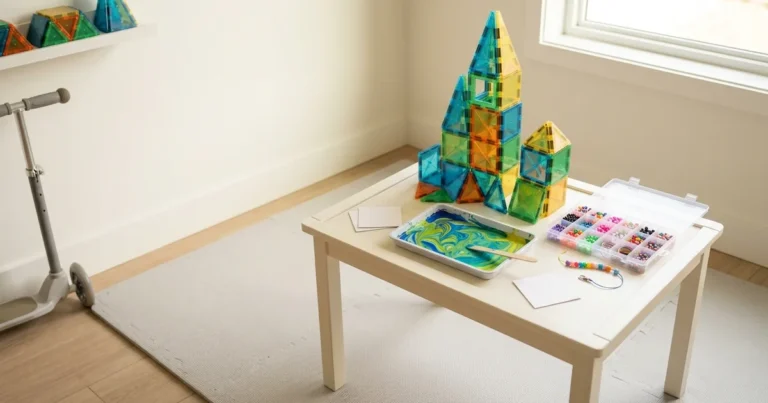
You do not need a large playroom to create an effective STEM learning space. A dedicated shelf or low table with two or three rotating toy sets is enough. Consider organizing your child’s STEM corner around three categories:
- Building and construction, such as magnetic tiles or train sets, for spatial reasoning and engineering play.
- Creative and sensory exploration, such as finger paints or textured materials, for early science and fine motor development.
- Logic and pattern games, such as puzzles or sorting toys, for early math thinking.
Rotate toys every few weeks rather than leaving everything out all at once. This keeps the space fresh, prevents overwhelm, and encourages children to engage more deeply with fewer items at a time, which is exactly how meaningful STEM learning happens.
Conclusion
STEM education for young children is not about early academics or pressure, it is about protecting and nurturing the curiosity children are already born with. With safe, well-chosen, age-appropriate toys, a little guided play at home, and support from a strong nursery or school program, UAE parents can raise confident, curious problem solvers without ever needing a worksheet. Start small, prioritize safety and quality, and let your child’s natural love of building, mixing, and asking questions do most of the teaching for you.
Frequently Asked Questions
At what age should I start introducing STEM toys to my child?
You can start as early as age 2 to 3 with simple, large-piece toys like magnetic tiles or stacking blocks. The key is choosing pieces that match your child’s fine motor stage and are certified safe for their age, rather than rushing into complex sets too early.
Are magnetic building toys safe for toddlers?
Yes, when they are designed with fully sealed magnets, rounded edges, and pieces large enough to avoid choking hazards. Always check for safety certifications like EN71 before purchasing, and supervise younger siblings if there are smaller pieces in the household.
How much time should young children spend on STEM play each day?
Ten to twenty minutes of focused, hands-on play is enough to see meaningful developmental benefit for preschoolers. Quality of engagement matters far more than duration, so let your child lead and stop when their interest naturally shifts.
Do STEM toys replace the need for structured preschool learning?
No, STEM toys are a strong complement to nursery or school learning, not a replacement. They reinforce concepts like spatial reasoning and problem solving at home, while a good early education program provides guided instruction and social learning.
What is the difference between a STEM toy and a regular toy?
A STEM toy is typically open-ended, encourages experimentation, and naturally introduces concepts like patterns, balance, or cause and effect, such as magnetic building sets. Regular toys can still offer value, but STEM toys are specifically designed to build problem-solving skills through repeated, hands-on use.